
Last Updated on January 14, 2026 by Admin
01] Introduction
Only 1-2% of students who appear for Prelims, quality for Mains. This leaves 98-99% of students behind, from the first stage of the exam itself.
In this, there are students who have studied hard for Mains, but are not able to crack Prelims, year after year.
Then there are also those who consistently clear this first stage of examination but get stuck in Mains. From 2nd or third attempt onwards, they don’t even give adequate time to Prelims, but are still able to clear the it. If you’ve ever been to Karol Bagh, or in touch with multiple UPSC aspirants, it’s not rare to find these kinds of people.
So, if some people are consistently failing, while others are consistently able to clear the exam, there is definitely a pattern to the exam. And what matters is, to figure it out and work on it.
In fact, with the very same purpose, we’re writing this series of articles, to assist you in Prelims preparation, and give you the coveted chance to write UPSC Mains. But, before we get into the details, it’s important to have a right mindset.

02] Mindset for Prelims Preparation
This design of the Prelims exam, which fails 98-99% of students, has created a narrative. Most of the students see Prelims as the ‘most difficult’ phase of exam, where we will never know what and how to study. This is similar to Indian elections, where the losing party puts entire blame on EVM machines. Blaming exam is much easier than blaming oneself.
Even some institutions have joined this narrative. They join students in criticizing the UPSC, to the extent of saying that ‘U’ in UPSC stands for ‘uncertainty’ and ‘S’ for ‘surprise’. If institutions and teachers themselves have such an attitude, they better be teaching how to play Dream11 than (mis)guiding UPSC aspirants.
Now, although UPSC Prelims syllabus is not as detailed as CSE Mains, it exists. Further, as mentioned above, there are people who’re consistently failing or passing the exam, suggesting an underlying pattern.
Secondly, when you assume that the exam is random, uncertain, impossible etc. there is no motivation to study. UPSC is more of a gambling than a game with clear rules. When you think that UPSC as an organization is conspiring against you, there is no hope for you to win. Such students are already out of the race.
If you want to clear UPSC Prelims, you’ve to take your own responsibility. If you’ve failed before, unless you acknowledge that something went wrong in your preparation last time, there is little hope for you. You’ve to know that there is a pattern that you just need to figure out, that UPSC is a fair body, and with proper strategy and adequate hard work, it is possible to clear UPSC Prelims, whether it’s your first attempt or last.
Assuming you’re onboard, let’s get started.


03] UPSC Prelims Subject Wise Weightage
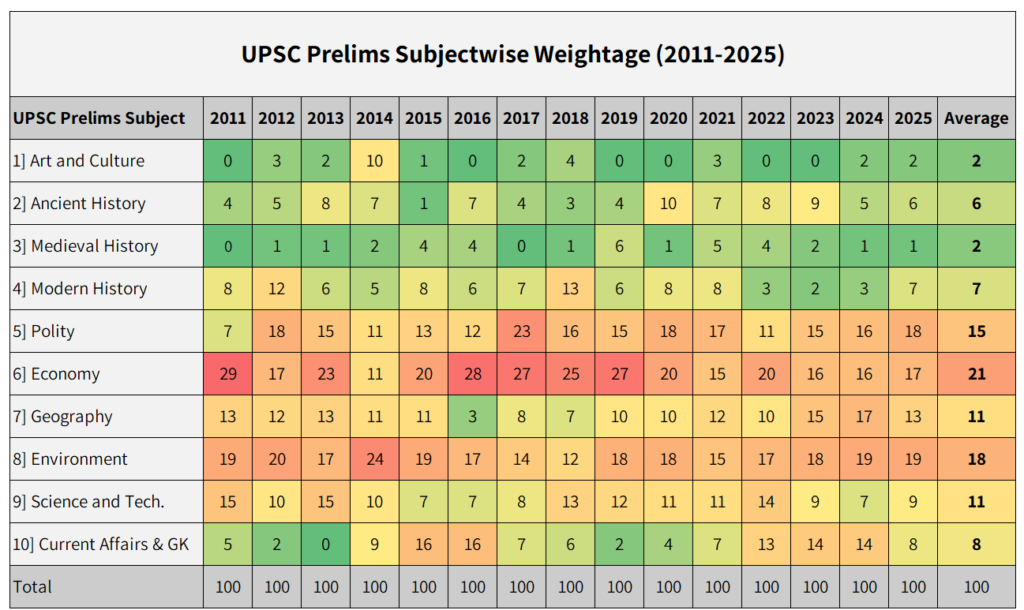
If you observe the above table, you will observe that Economy, Environment, Polity and Geography are the most important subjects of all. More than 60% questions come from these 4 subjects alone. So, it would be prudent to start with them.
Do spend some more analysing the above table.
We do have a detailed article on subject wise classification and analysis of UPSC Prelims, please go through it as well.
04] Making Schedule for Prelims Preparation
There are two important parts of Prelims preparation.
Part 1] You need to study each subject thoroughly and multiple times.
Part 2] You need to solve an adequate number of mock tests to refine your understanding and strategy.
Accordingly, for Part 1] i.e. studying individual subjects, we recommend the following schedule. Part B should start a little later, and we’ve discuss it in a separate article, but that can be referred later – Part 2] Schedule for Mock Tests
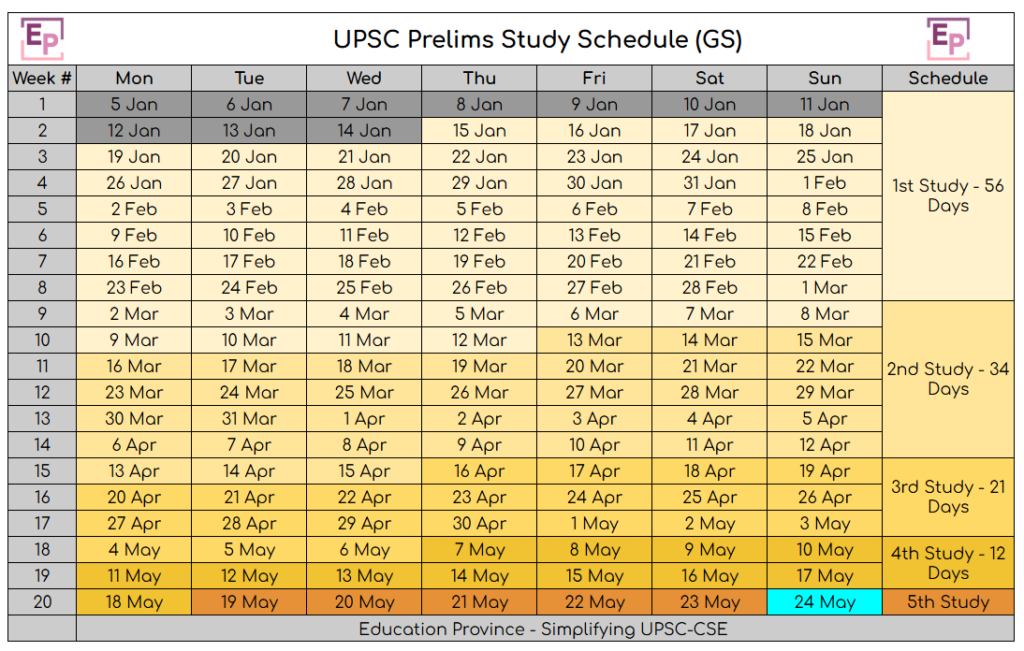
We’re assuming that you’re starting your studies from 15th Jan. However, some 4-5 days plus minus can happen, and you can adjust the schedule accordingly. You can also make some more tweaks to this schedule and make your own. Refer below google sheet to make customizations.
05] First Reading of Entire Syllabus
There are 10 subjects in Prelims, which can be divided into 4 groups i.e.
- Indian Economy + Polity
- Environment + Geography
- Science & Tech + Current Affairs & General Knowledge
- Art & Culture + Ancient History + Medieval History + Modern History
For first reading, we recommend following time table:
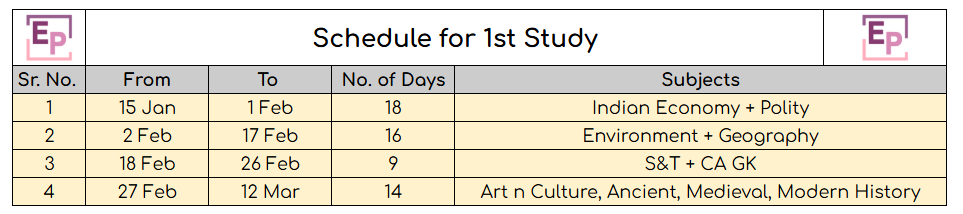
Similarly, we’ve suggested schedules for 2nd and later readings in the below Google Sheet.
As far as mock tests are concerned, we recommend that you should be doing subject wise mock tests till you finish first reading of all subjects, and start with full length mocks after that (around 11th March). A schedule for that is discussed separately in this article.

Studying Individual Subject in First Reading
We also recommend a Standard Operating Procedure (SOP) one should follow while reading a particular subject. For the list of books that we recommend, you can refer to this UPSC Prelims Booklist by Toppers.
1] First, start by understanding the syllabus of that subject. That can be done by using PYQs, classified into various topics. Know that syllabus for Mains and Prelims are slightly different, so Mains syllabus copy won’t help.
For example, you can refer to this link for Polity topic wise questions. As you can see, there are 15 subtopics to Polity (A to O in the index). As you read Polity by Laxmikant, you can ensure that you are completing each of the topics from above 15. Now, some of the topics may not get covered in the Indian Polity book, and you may have to prepare your own notes, or look somewhere else to ensure that particular subject is prepared thoroughly.
When it comes to reading from the book, we recommend the following strategy.
- Read the PYQs on that particular topic you’re planning to study. The intention of this reading is to get acquainted with the kind of questions asked from that topic.
- Reading of PYQs should be followed by actual reading of the topic from the book you’re using. You can also refer to PYQs in between if required.
- After reading the topic, you should again read the PYQs on that topic and try to mentally answer them. This is just to check your understanding of the topic. If you’re not able to answer something, just go back to reading that particular heading in your book again. Sometimes, some question may not be there in your book altogether, in such cases, you can add related info in your book itself (for future reference).
Following the above three step formula, complete the entire subject, and then finish first reading, by completing all subjects. This much is sufficient in the first reading of the syllabus.
You will need a slightly different approach for S&T and Current Affairs, but we’ll discuss that later.

What Next
The reading of subjects should be followed by subject wise tests to check your understanding. We’ll discuss that, and some other topics as we go deep in preparation.
You can check other articles in this series here.
Please feel free to ask if you have any questions on the subject matter. We’ll be glad to answer them. We may write a separate article altogether if many students are facing a similar issue. Let us know.
Best wishes for your preparation!
Regards,
Abhijeet Pimparkar
Regarding CSAT
The article discusses the preparation mostly from GS perspective. Yes, CSAT is also a big challenge for many students, but unfortunately we’ll not be able to cover that in similar details. We do have one article dedicated to CSAT, but that mostly deals with CSAT paper, and not comprehensive study of CSAT. We recommend doing CSAT parallel to GS studies… devoting 1-3 hrs. everyday, depending on your background and expertise in mathematics.
Best wishes again!
thanks
thanku so much sir
Great
sir/madam i don’t know who is handling this site but this would be my 3rd attempt in four years of prep this site is game changer i bet i would have cleared earlier if i know it in before attempts thank you for your service !!great work thank you would be a quasar in galaxy for the knowledge you are sharing!!