
Last Updated on February 10, 2026 by Admin


1] Introduction
When it comes to Prelims preparation, the list of obstacles never ends. However, what trumps all of them is the fear of current affairs. This is the part which gives UPSC Prelims the attributes like uncertain, totally random, or ‘the most difficult exam in the world’. Of course, UPSC-CSE is difficult. But not to the extent it is often believed, and definitely not impossible.
2] Common Questions About Prelims
When I talk with students regarding current affairs, the common arguments include ‘current affairs occupy almost half of the total questions’, ‘current affairs is totally unpredictable’, ‘current affairs is so vast’, ‘I have not read any newspaper for the whole year’, ‘even institutes’ current affairs material is not reliable’ and so on… the list does not end.
I have been of the opinion that the role of current affairs in Prelims is exaggerated. My beliefs were strengthened when both times (2019, 2020), I could clear the Prelims when I had not read the newspaper for almost an entire year. I also observed a similar trend with a few of my friends and students. Afterwards, with the publication of our Prelims PYQ Book (1995-2025), I had data to back up the theory.
3] Exactly How Many Current Affairs Based Questions?
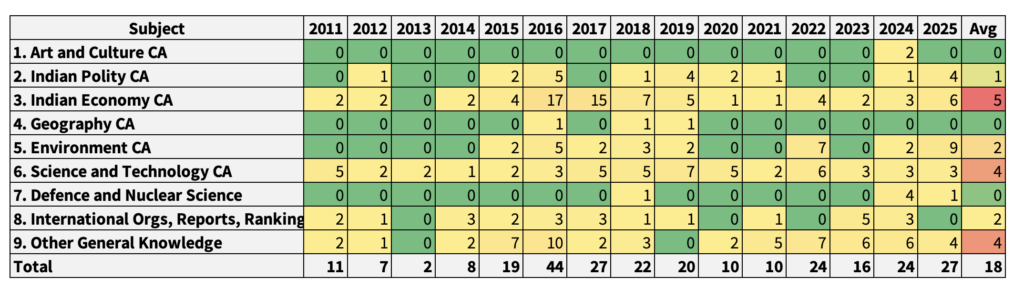
The below table breaks down current affairs based questions in various subjects i.e. Polity related current affairs (CA), Economy related current affairs etc. Next to subjects is the number of questions UPSC asked from that subject in a particular year.
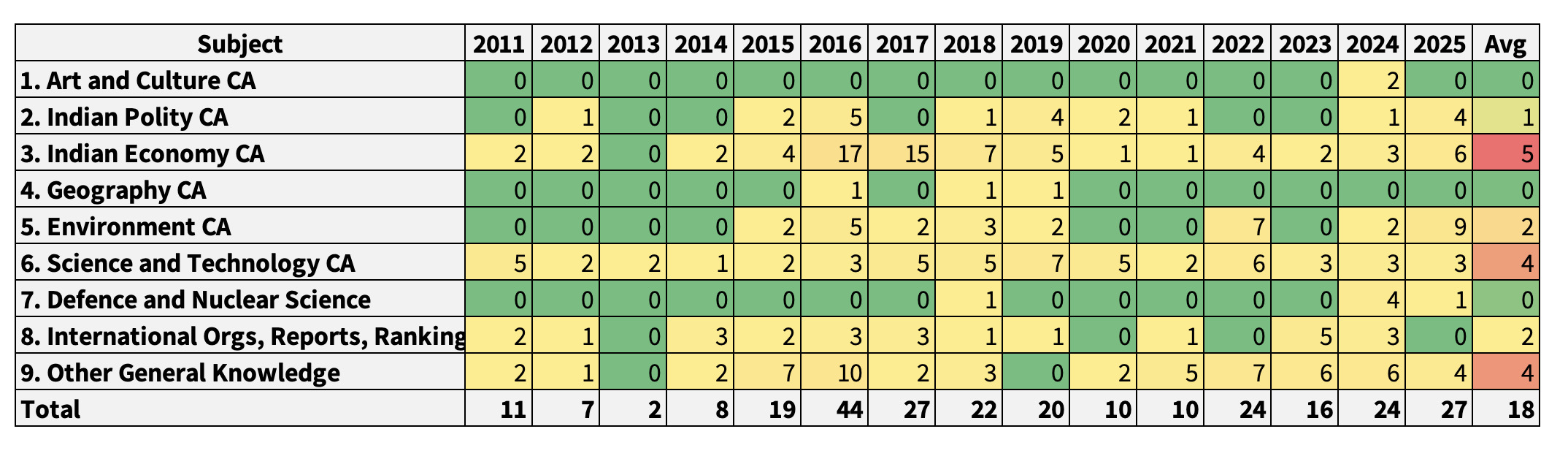
As you can see in the above table, on average, UPSC has asked about 18 current affairs based questions across all subjects. Year 2016 was exceptions when a lot of current affairs based questions were asked. This can be attributed to the fact that a new government had come in and a lot of policies, schemes were renamed, newly introduced etc. Since then, UPSC has not asked more than 27 current affairs based questions in a particular year.
4] What Current Affairs Consists of?
As you can see in the above table, Current Affairs does not consist of a single subject. It covers the latest happenings related to all subjects that we normally study.
Seen from this perspective, only topics 8] and 9] from the above table are purely current affairs (8. International Orgs. Reports & Rankings & 9. Other General Knowledge). From these two topics i.e. 8 & 9, only 6 questions have been asked on average.
Thus, you get around 15-25 current affairs questions in total paper. Out of these, most questions are based on current affairs related to static subjects like Polity, Economy, etc. and few questions are not related to any subject from the static syllabus (topics 8 & 9 from above table).
5] Mindset for Current Affairs.
Before getting into what exactly to do about current affairs, something else is more important to understand.
Know that to a large degree, current affairs are random. While UPSC asks only questions from important areas, there can be 100s or even 1000s of such important areas in a particular year, and UPSC only has to ask 10-20 questions from that.
Further, the content for Current Affairs is very vast. Given the randomness as said above, it is almost impossible to have more than 50-60% accuracy in current affairs. And even the current affairs questions you’ll end up answering will be partly by luck.
Thus, normally, even if you study very well for current affairs, you cannot have accuracy more than 50%. In other words, you cannot get more than 50% of current affairs questions correct, no matter what you do.
Good news is, we don’t need that. In UPSC Prelims as a whole, a target of 110-120 marks is quite reasonable. Which invariably means that some questions are going to be left behind. And if that is the case, it better be the random question from current affairs, than some easy ones from Polity or Economy.
This is the part of preparation many students find difficult to understand and digest. While some do, they fall short when it comes to execution. You need to understand that you cannot, and you don’t need to score 200/200 in Prelims. Scoring 110-120 is sufficient, and will help you get through Prelims.
On the flip side, it also doesn’t mean that you have to leave current affairs altogether. It simply means that you cannot have a good accuracy in Current Affairs, despite studying everything you can, and that is okay. You can still clear the exam.
6] What to do?
It all boils down to a simple but a profound phrase. “do your best and leave the rest”. The advice is so simple to understand, yet so difficult to follow. Generally if we’re doing our best, we also want to do it comprehensively. And we have to leave, we just want to leave it altogether.
To overcome this dilemma, you should decide on certain material for current affairs and stick to it. We would simply recommend doing Vision IAS Current Affairs magazines which are freely available to download (link here). You can download them, print them, and revise multiple times. These magazines cover current affairs related to each subject i.e. polity, economy, environment etc. Apart from these, you should only do some static content on Science & Tech, which we’ll discuss in the second part of this article.
Just do monthly magazines from May 2024 onwards and there is no need to refer to PT 365 as well.
(Note: You can also do CA magazines from other institutions if you’ve used them before, or you find them better than Vision IAS. The important point is, to choose a standard resource and stick to it and do multiple revisions of it.)
Also, as you go on solving mock tests, and come across certain current affairs related facts, which are not covered in your CA magazines, you should just add it to your magazine in the relevant section and move on. There is no need to panic or change your sources if you come across such new questions.
Fixing boundaries like this will give you a peace of mind when it comes to current affairs. This will also let you focus on other areas of preparation which are more important.

7] Preparing for Science and Technology
Science and Technology is often treated as current affairs by the students and hence we’re discussing it in this article itself. The below chart suggests the total number of Science & Tech questions asked from 2011 year vis-a-vis current affairs based S&T questions.
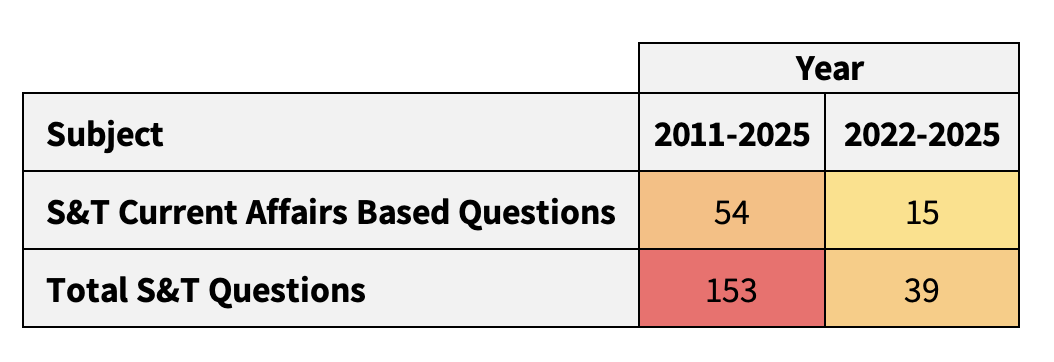
As you can see, a little over one third of total S&T questions are current affairs based i.e. Out of 39 S&T questions from 2022, only 15 have been CA based i.e. rest 24 were from the static part of Science & Tech.
8] Science and Technology Syllabus
Analysis of 2011 onwards Prelims Questions suggests following syllabus for Science and Technology, covering both static and current affairs oriented part.
A) Electronics and IT
This topic is largely current affairs based. However, some questions can be asked from static knowledge as well e.g. use of accelerometer. Further subtopics in this include – latest developments in electronics, telecommunication, information technology, cyber technology etc.
B) Astrophysics and Space Technology
To a large extent, this topic is static. Breakthroughs rarely happen in space technology, and current knowledge systems have been developed over years. You should have a good knowledge of the Solar system, astronomy, galaxy and other important topics and terminology of astrophysics, various space launch vehicles/ satellites, the way they function etc. Recent and significant missions of ISRO, NASA and other space agencies.
C) Biotechnology
Latest advances in the field of medical sciences and biology, genetic modification technology, DNA, nanotechnology in medical science, vaccine development etc.
D) Physics
General physics, with special emphasis on particle physics and nuclear physics
E) Chemistry
General chemistry
F) Biology
General biology with special emphasis on biology related to human beings
G) Diseases
A subtopic of biology, which discusses diseases, causes and means of transmission, prevention methods etc.
If you have any doubt about the above classification of syllabus, we strongly recommend referring to the Science & Technology Previous Year Questions (1995-2025) and come to the conclusion on your own.


9] Sources to Study Science and Tech
This is another important question that needs answering.
As suggested above, there are two parts to Science and Technology i.e static and current affairs oriented. For the CA part, just stick to the monthly magazines you’ll be doing. These will have a S&T section separately. For the static part, we would recommend McGraw Hill Publications’ Science and Technology book by Ravi Agrahari (Link here). (Not a sponsored product) Our sincere assessment of the book suggests that it covers almost all of static Science & Tech as we have suggested above.
Also, if you’ve used any other book which also covers most of the syllabus suggested above. Or, if you find a better book than what we’ve recommended, feel free to go ahead with it. Just ensure that it covers most of the syllabus we’ve recommended above. The important point is – you do it thoroughly and do multiple revisions of it.
10] Conclusion
Strategy like above should be more than sufficient to cover Science & Tech and Current Affairs. Just ensure that you thoroughly complete the two sources we’ve mentioned i.e. monthly magazines of a particular institution (e.g. Vision IAS), and McGraw Hill’s S&T Book (or another similar book of your choice). Ensure multiple revisions of these two resources, and you’re good for these two subjects for Prelims.
Best wishes for your preparation!
Amezing explain